
SSAW Pipe

Overview of SSAW Pipe
SSAW Steel Pipe Specifications
- Lightly Oiled: Provides temporary corrosion protection during storage and transport.
- Hot Dip Galvanized: Offers excellent corrosion resistance through a zinc coating.
- Electro Galvanized: Provides a thinner zinc coating for indoor applications.
- Black: Suitable for applications where a natural appearance is desired.
- Bare: Uncoated steel suitable for dry environments with low corrosion risk.
- Varnish Coating/Anti-rust Oil: Provides additional protection against corrosion during storage.
- Protective Coatings: Options such as Coal Tar Epoxy, Fusion Bond Epoxy, and 3-layers PE offer enhanced corrosion resistance for demanding environments.
| Production Process | SSAW Pipe | ||
| Outside Diameter | 219.1mm – 2032mm / 8″ – 80″ | ||
| Wall Thickness | 6mm – 25.4mm (SCH 20 – SCH XXS) | ||
| Pipe Length | 3 – 18 meters | ||
| Production Standards | API 5L | EN 10217 | ASTM A500 |
| ASTM A53 | EN 10219 | – | |
| Corrosion Prevention | Lacquer, Varnish, Oiling, HDG, Pre-Galvanizing | ||
| FBE, 2LPP, 3LPP, 2LPE, 3LPE | |||
| End Processes | Square Cut, Bevelling, Threading, Grooving | ||
| Joint Method | Fitting, Flange, Coupling, Clamp, Pipe Shoulder, Welding | ||
| Further Processing | Welding, Bending, Hole Drilling, Punching, Swaging, Tapering, Flaring, Expanding | ||
| Product Usage | Petroleum, Liquid & Gas Transmission, Structure, Piling Job, Mining, Agriculture, Fabrication, Fire Fighting, Heat Exchanging | ||
Production Standards of SSAW Pipe
- API 5L: This standard is widely used for line pipes used in oil and natural gas industries. It specifies the requirements for manufacturing, testing, and delivery of seamless and welded steel pipes.
- ASTM A252: This specification covers welded and seamless steel pipe piles. It is commonly used in construction projects involving deep foundations, such as marine structures and bridge abutments.
- ASTM A53: This specification covers seamless and welded black and hot-dipped galvanized steel pipe in NPS 1/8 to NPS 26 (DN 6 to DN 650). It is often used for mechanical and pressure applications as well as ordinary uses in steam, water, gas, and air lines.
- ASTM A500: This specification covers cold-formed welded and seamless carbon steel structural tubing in round, square, rectangular, or special shapes. It is used primarily for structural applications in construction.
- ASTM A795: This specification covers black and hot-dipped zinc-coated (galvanized) welded and seamless steel pipe for fire protection use. It is commonly used in fire sprinkler systems and related applications.
- API 5CT: This standard specifies the technical delivery conditions for steel casing and tubing pipes used in oil and gas wells. It covers various grades and sizes of casing and tubing pipes to ensure integrity and performance in oilfield operations.
What is SSAW Pipes Used for?
- Oil and Gas Transmission: Extensively used for transporting oil, natural gas, and other petroleum products over long distances.
- Water Transmission: Used in water supply systems for transporting potable water, wastewater, and irrigation water.
- Construction and Structural Applications: Employed in construction projects for structural purposes such as piling, foundation supports, and structural columns. Their strength and load-bearing capacity make them suitable for building bridges, buildings, and other infrastructure.
- Piling: Commonly used as foundation piles in civil engineering projects, including bridge construction, marine structures, and waterfront structures. They provide strong support for structures in challenging soil and water conditions.
- Steel Fabrication: SSAW pipes are essential in steel fabrication processes, where they are used to create various steel structures and components, ensuring strength and durability in finished products.
- Mechanical Engineering: In mechanical engineering, SSAW pipes are used as structural components and parts of machinery, providing the necessary strength and support. For example, they can be used in the manufacture of frames, support structures, and other components of large machinery that require high strength and durability.
Water Transmission
Piling Work
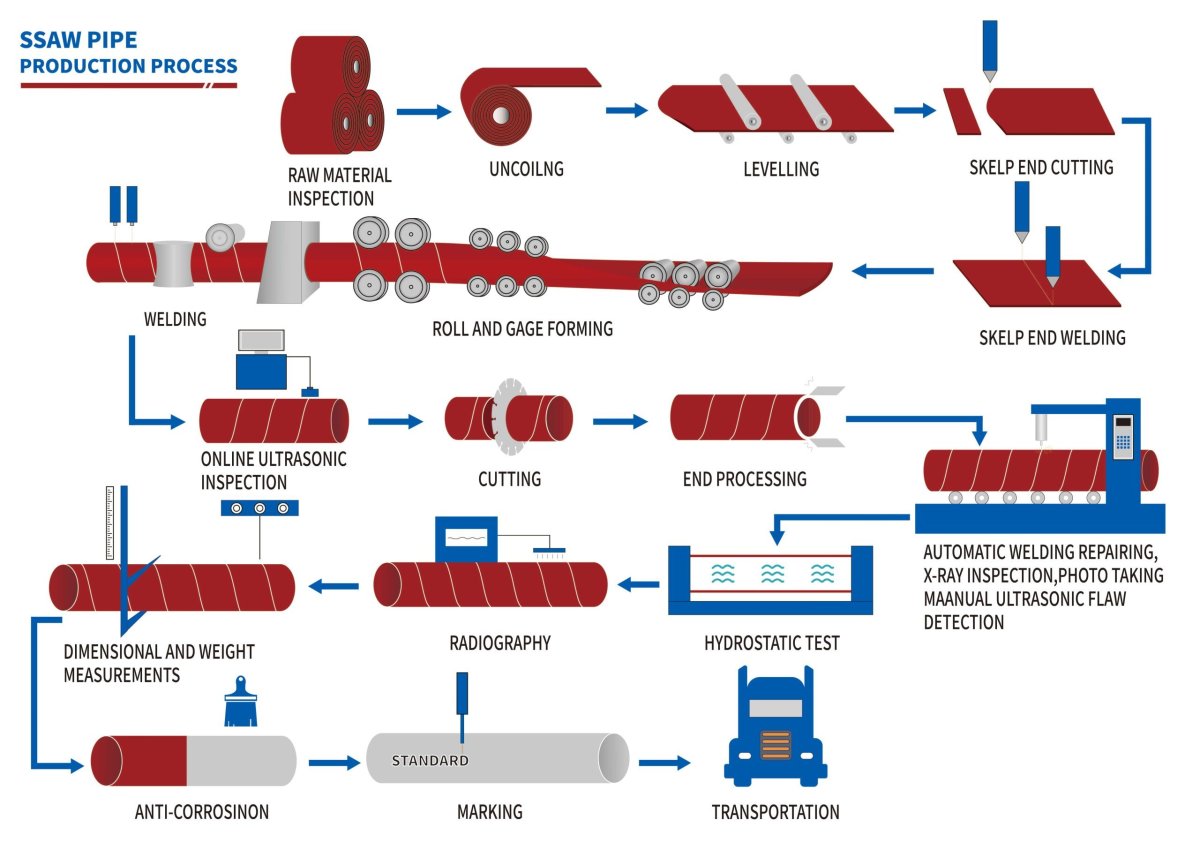
What is SSAW pipe Manufacturing Process?
The manufacturing process of SSAW pipes is a blend of precision and innovation. It begins with the formation of pipes by rolling and welding a steel strip in a helix or spiral direction, creating a weld seam in a spiral line. This spiral welding is achieved using the submerged arc method, which relies on the tandem welding technique. This technique ensures the joining of the trimmed and beveled coil edges, resulting in a high-quality weld structure. Special systems like the Thermatool Spiral Seam Annealing are employed, requiring the installation of custom-designed “shaped” inductors. Every step is meticulously executed to ensure that the final product stands as a testament to quality and durability.
What is the difference between SSAW pipe and LSAW pipe?
When it comes to SSAW and LSAW pipes, understanding the differences is crucial for making an informed decision. SSAW pipes are welded in a helix or spiral position, while LSAW pipes are welded longitudinally. This fundamental difference in welding direction affects their pressure-bearing capacity and manufacturing ease. LSAW pipes, being longitudinally welded, have a higher pressure resistance and are typically used for high-pressure services. In contrast, SSAW pipes, with their spiral weld, are more suited for low-pressure services. Additionally, LSAW pipes have better geometry accuracy, lesser welding line, and undergo a more rigorous testing process. While both types have their unique advantages, LSAW pipes generally have a slight edge in terms of quality and application. However, the choice between the two ultimately depends on your specific needs and the nature of your project.
SSAW Pipe
- Low cost
- Welding Direction: Spiral direction
- production efficiency:High efficiency
- Outer Diameter: 20 inch to 100 inch
- Main Application: Construction
- Thickness Tolerance: Relatively accurate
- Geometry accuracy: Low
- Relatively expensive in price
- Welding Direction: longitudinal direction
- production efficiency:Low Efficiency
- Outer Diameter: 16 inch to 60 inch
- Main Application: medium/high pressure
- Thickness Tolerance: Relatively accurate
- Geometry accuracy: High
Coating Standards for SSAW Pipes
Types of Coatings
Fusion Bonded Epoxy (FBE) Coating:
- Standard: ISO 21809-2, AWWA C213
- Application: Applied as a powder that melts and forms a protective layer. Ideal for corrosion protection in buried or submerged pipes.
- Benefits: Excellent adhesion, chemical resistance, and flexibility.
Three-Layer Polyethylene (3LPE) Coating:
- Standard: DIN 30670, ISO 21809-1
- Application: Consists of an FBE base layer, a copolymer adhesive layer, and a polyethylene topcoat. Applied to protect against corrosion and mechanical damage.
- Benefits: High durability, resistance to impact and abrasion, and effective barrier against moisture and chemicals.
Three-Layer Polypropylene (3LPP) Coating:
- Standard: DIN 30678, ISO 21809-1
- Application: Similar to 3LPE but uses polypropylene for higher temperature resistance.
- Benefits: Superior mechanical protection and temperature resistance, ideal for high-temperature applications.
Coal Tar Enamel (CTE) Coating:
- Standard: AWWA C203
- Application: A combination of coal tar, plasticizers, and reinforcing agents, typically applied with a fiberglass wrap.
- Benefits: Excellent water resistance, durability, and cost-effectiveness for underground and submerged environments.
Galvanized Coating:
- Standard: ASTM A123, ASTM A153
- Application: Hot-dip galvanizing where the pipe is dipped in molten zinc to form a protective layer.
- Benefits: Strong corrosion resistance, especially in atmospheric conditions, and a long service life.
Epoxy Coating:
- Standard: AWWA C210
- Application: Liquid epoxy applied by spraying or brushing, often used for internal linings.
- Benefits: Smooth surface for reduced friction, good chemical resistance, and protection against microbial corrosion.


